Stop Eating Less. Start Eating Different.
You’ve Heard it a Thousand Times.
“Weight loss is simple, just eat less and move more.”
It sounds logical. It feels like common sense and it is one of the most damaging pieces of health advice in circulation today.
Not because it’s technically wrong in a physics sense a caloric deficit does produce weight loss. But because it fundamentally misunderstands how human beings actually eat, why we eat the way we do, and what happens to our bodies and minds when we try to simply eat less food.
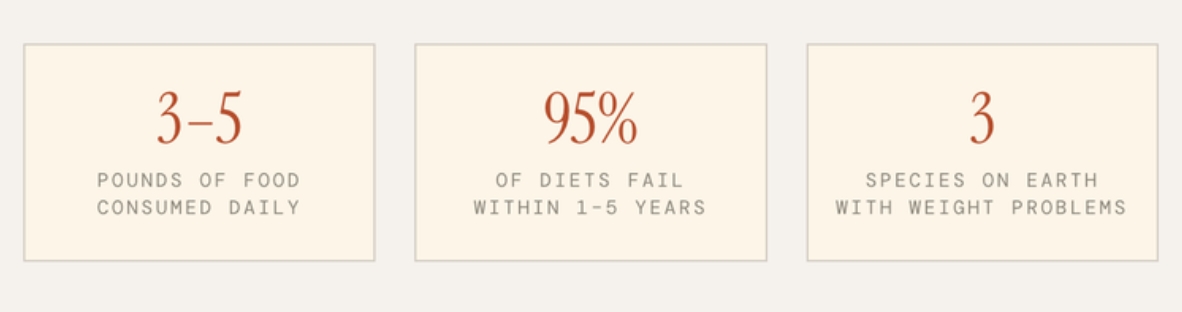
If this advice worked, the problem would have been solved decades ago. Instead, research consistently shows that the vast majority of calorie-restriction diets fail within one to two years, not because people lack discipline, but because the strategy itself is incompatible with human biology.
Let’s talk about why and more importantly, let’s talk about what to do instead.
Your Body Doesn’t Count Calories, It Counts Volume.
Here’s something most diet advice ignores entirely: humans are wired to eat a relatively consistent weight of food each day, somewhere in the range of three to five pounds, depending on the individual. This isn’t a conscious choice. It’s a deeply embedded regulatory behavior shaped by hundreds of thousands of years of evolution.
Your stomach has stretch receptors, your gut has nutrient sensors, and your brain has satiety signals tied to volume and weight, not to an abstract calorie number printed on a label. When you’ve consumed enough physical food, your body tells you to stop. When you haven’t, it tells you to keep going.
This is why you can eat an enormous salad and feel satisfied, even though the calorie count is modest and it’s why you can eat a small bag of nuts, take in 600 calories, and feel like you barely ate anything. Your body is tracking mass. Your diet app is tracking energy. They are not measuring the same thing.
Why “Eating Less” Triggers a Survival Response.
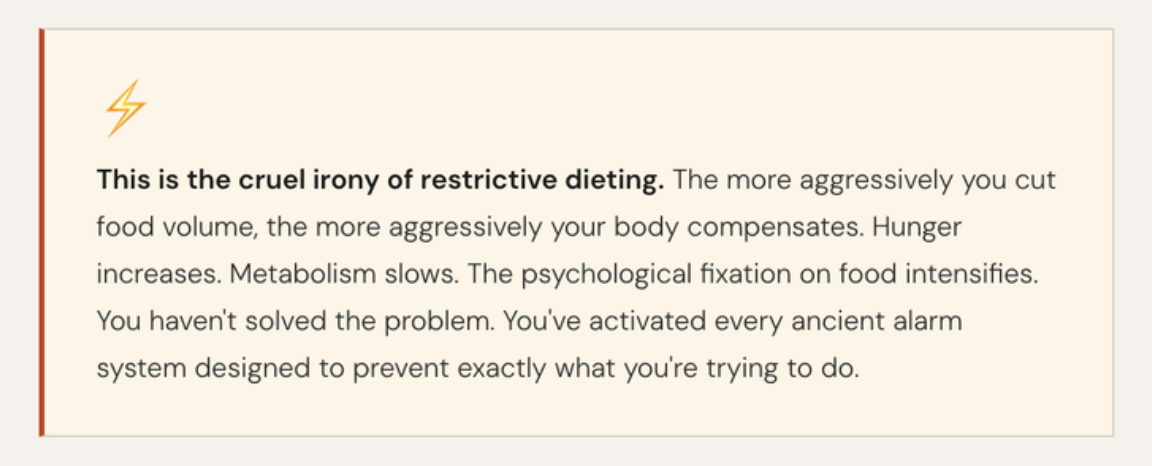
When you reduce the volume of food you eat, when you literally put less on the plate, skip meals, or shrink portions, your body doesn’t interpret this as a smart strategy. It interprets it as a threat.
We evolved in environments where food scarcity was the primary danger. Our ancestors who survived periods of famine were the ones whose bodies responded to reduced food intake with powerful biological countermeasures: increased hunger hormones, decreased metabolic rate, heightened food-seeking behavior, reduced impulse control around food, and a dramatic increase in the reward value of calorie-dense options.
In other words, the moment you start eating less food, your body begins fighting you hard to get you back to eating more. This isn’t a willpower problem. It’s an evolutionary pressure that your conscious mind was never designed to override indefinitely. The people who could override it were the ones who starved to death. You are descended from the ones who couldn’t.
The Proof Is Living in Your House
Here’s a question that should stop you in your tracks: There are only three species on planet Earth that have a widespread obesity problem. Humans, Dogs, and Cats.
What do these three species have in common? They all live in human houses. They all eat from the human food environment.
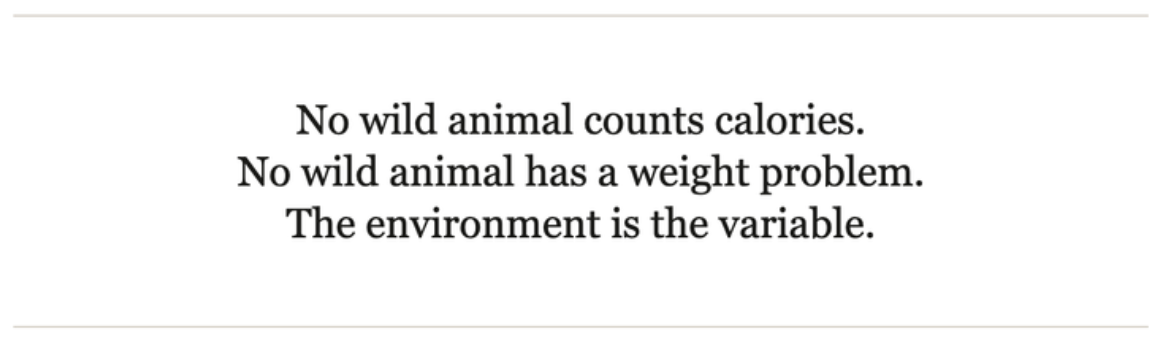
Wild wolves don’t have weight problems. Feral cats don’t have weight problems. No animal in its natural habitat, eating its natural diet, struggles with chronic weight gain. It is not the animal that is broken. It is the caloric environment.
We have engineered a food environment where the most accessible, most affordable, most convenient, and most heavily marketed options are extraordinarily calorie-dense. Fast food. Processed snacks. Refined oils and sugars. These foods pack enormous caloric loads into very small volumes. Your body eats its natural weight of food, but the energy content of that food has been artificially concentrated far beyond anything found in nature.
This is not a discipline problem. It’s a design problem.
The Real Solution: Calorie Density
If the problem is the caloric environment, the solution is to reshape that environment, not to fight your own biology with willpower and restriction.
This is where the science of calorie density changes everything. Calorie density is simply the number of calories per unit of weight in a given food and the range is enormous:
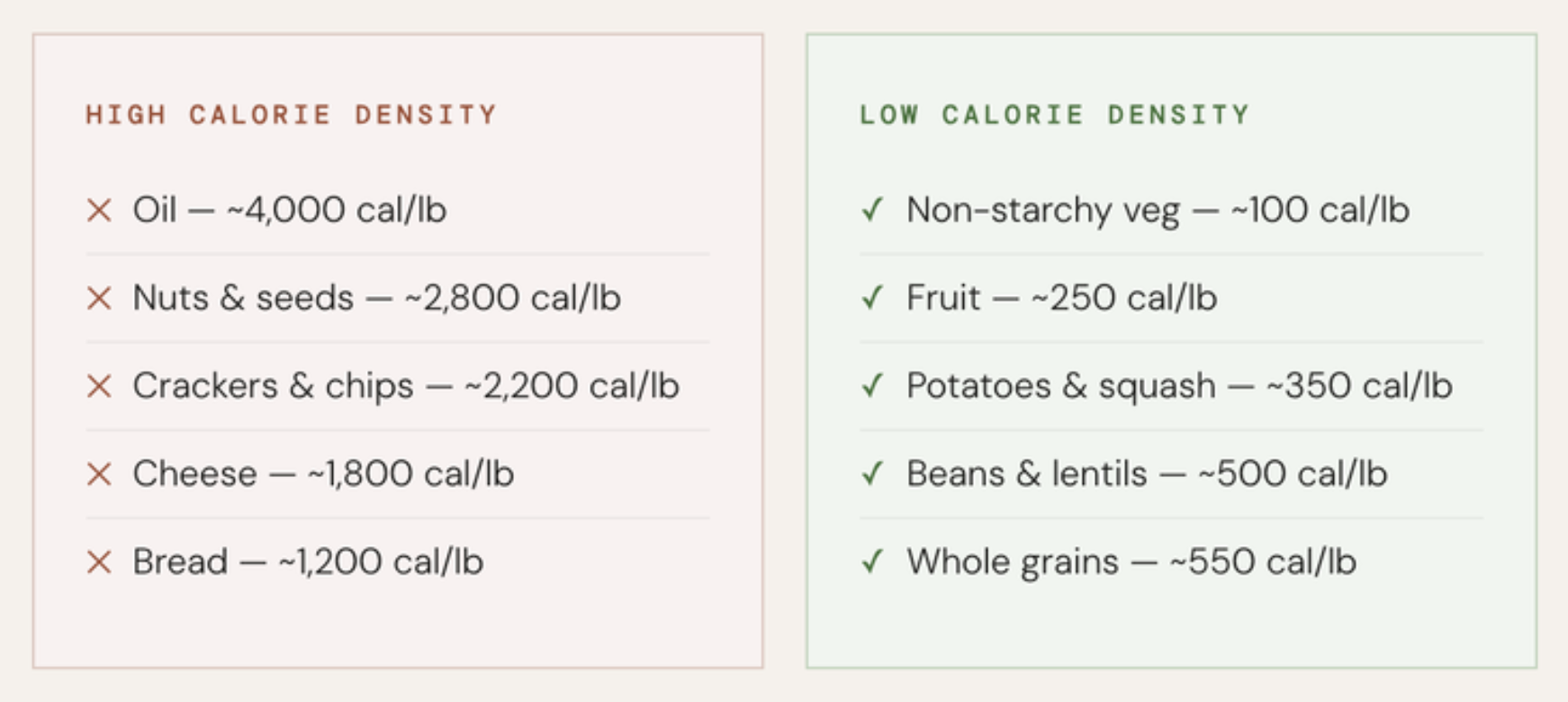
Look at that range. You could eat the same physical weight of food, satisfying your body’s natural volume requirements completely and consume dramatically different total calories depending on where those foods fall on the calorie density spectrum.
This is the shift. You don’t eat less. You eat differently. You build a plate that is anchored in the lower end of the calorie density spectrum, vegetables, fruits, whole grains, legumes, potatoes and you let your natural hunger signals do what they were always designed to do: regulate your intake.
No counting. No measuring. No white-knuckling through the afternoon. You eat until you’re full. You just do it with foods that allow fullness and a healthy caloric intake to coexist.
Work With Your Nature, Not Against It
The entire “eat less, move more” paradigm frames your body as the enemy, something to be overridden, outsmarted, and controlled. Calorie density offers a fundamentally different relationship with food and with yourself.
Your hunger is not the problem. Your desire to eat a satisfying volume of food is not a flaw. These are features of a beautifully calibrated system that kept your ancestors alive for millennia. The only thing that has changed is the food itself.
When you understand calorie density, you stop fighting and start designing. You design your kitchen, your meals, your snack environment, and your default choices so that the path of least resistance, eating the way your body naturally wants to leads to the outcome you’re looking for.
The animals in the wild have this figured out by default. The food in their environment matches their biology. Your job is to do the same thing, consciously, deliberately in a world that has made it difficult by design.
That’s not restriction, that’s intelligence.